Data Tells a Story: How to Measure What Really Matters
Data Tells a Story: How to Measure What Really Matters
By Willie Finklin, CFRE, The Grant GOAT
If I asked you how successful your nonprofit has been this year, how would you answer?
Would you tell me how many people attended your events?
How many volunteers signed up?
How many meals were served?
How many backpacks were distributed?
Those numbers certainly matter. They help tell part of your story, and every nonprofit should celebrate the lives it touches. But here's the question every nonprofit leader eventually has to answer.
Did your work actually change anything?
That's where many organizations struggle.
I've worked with nonprofits that could tell me exactly how many people participated in their programs but couldn't explain what happened after those participants went home. Did students improve academically? Did families become more financially stable? Did participants find employment? Did health outcomes improve? Did anyone's life truly change because of the program?
Funders, donors, and community partners are asking those same questions.
The nonprofit sector has evolved. It's no longer enough to demonstrate activity. Organizations are increasingly expected to demonstrate impact.
The good news is that measuring impact doesn't require expensive software or a team of researchers. It simply requires intentional planning and a commitment to understanding whether your work is producing the results your mission was created to achieve.
Let's look at how your nonprofit can begin measuring what truly matters.
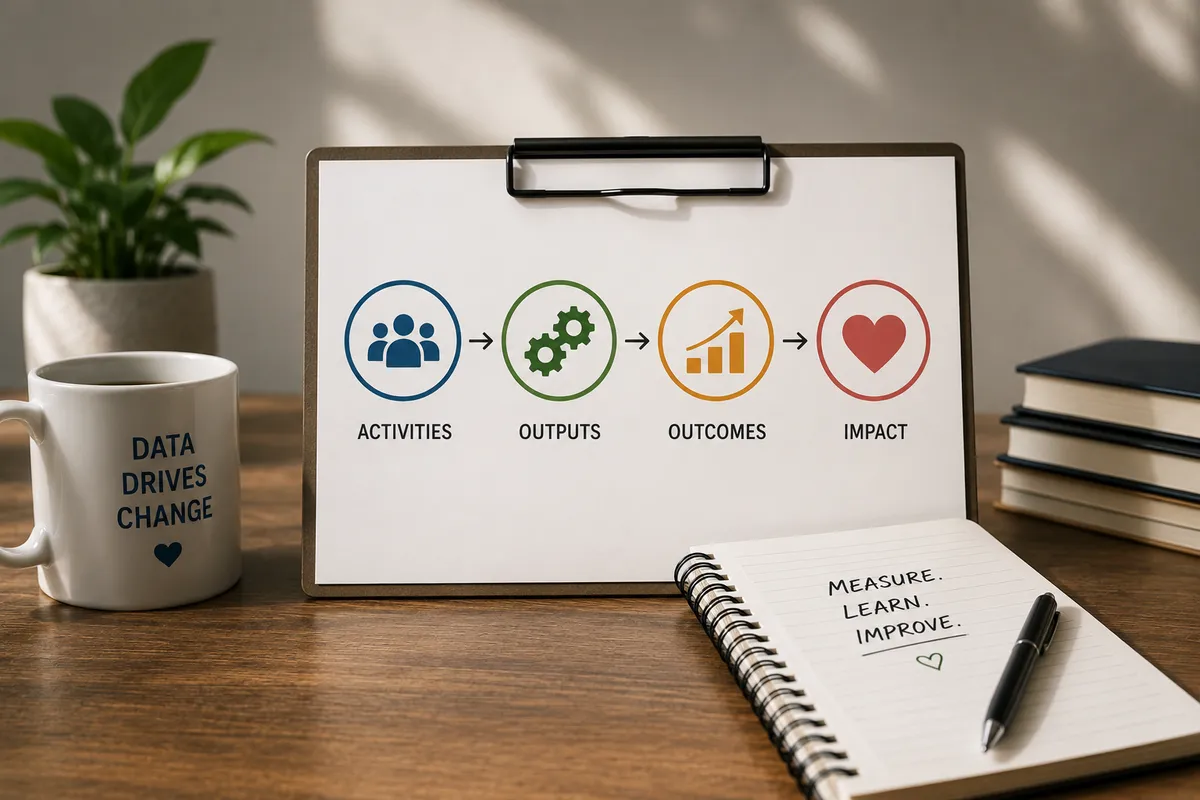
1. Outputs Tell People What You Did. Outcomes Tell People What Changed.
One of the most common mistakes nonprofits make is confusing outputs with outcomes.
Outputs are the activities your organization completes. They're easy to count because they're tangible. You know how many workshops you hosted, how many volunteers participated, how many meals were served, or how many backpacks were distributed.
Outcomes go one step further.
They answer the question, "What happened because of those activities?"
For example, serving 500 meals is an output. Improving food security for 200 families is an outcome. Hosting a financial literacy workshop is an output. Helping participants increase their savings or reduce debt is an outcome.
Both are important, but outcomes demonstrate impact. They help funders and donors understand that your organization isn't simply providing services. It's creating meaningful change within the community.
2. Start Measuring Before the Program Begins
One reason many nonprofits struggle with evaluation is because they wait until the end of the program to think about data.
By then, valuable information has already been lost.
Before launching a new program, ask yourself a few simple questions.
What problem are we trying to solve?
What would success look like?
How will we know if we've achieved it?
What information do we need to collect along the way?
Answering these questions early allows your organization to build evaluation into the program instead of treating it as an afterthought. Staff understand what information needs to be collected, participants know what to expect, and leadership has meaningful data available when it's time to report results.
Planning first makes evaluation much easier later.
3. Numbers Matter, But Stories Bring the Numbers to Life
Data and storytelling should never compete with one another.
They work best together.
Imagine telling a donor that your organization helped 150 students improve their reading scores during the school year. That's impressive.
Now imagine pairing that statistic with the story of one student who entered the program struggling to read at grade level but finished the year reading confidently in front of their classmates.
The data provides credibility.
The story provides connection.
Funders appreciate both because together they paint a complete picture of your organization's impact. Numbers demonstrate accountability, while stories remind people that every statistic represents a real person whose life has been changed.
The strongest nonprofit communications always balance facts with human experiences.
4. Collect Data That Helps You Make Better Decisions
Evaluation isn't just about satisfying grant requirements.
It's about helping your organization improve.
Too often, nonprofits collect information because a funder asked for it, then never look at the data again after the report has been submitted.
That's a missed opportunity.
Good data should help answer important leadership questions.
Which programs are producing the strongest outcomes?
Where are participants struggling?
Are certain services more effective than others?
Do we need to adjust our approach?
Data becomes valuable when it's used to make decisions. It allows nonprofit leaders to identify what's working, recognize areas for improvement, and allocate resources more effectively.
Organizations that learn from their data continue to improve over time.
5. Don't Measure Everything. Measure What Matters Most.
One mistake organizations often make is trying to collect too much information.
Every survey becomes longer.
Every form asks more questions.
Staff spend more time entering data than serving participants.
Eventually, evaluation becomes overwhelming.
Instead, focus on collecting information that directly relates to your mission and program goals.
Ask yourself whether each piece of data helps answer an important question about your organization's effectiveness. If it doesn't, it may not need to be collected.
Simple evaluation systems that consistently measure meaningful outcomes are often far more valuable than complicated systems that no one has time to maintain.
Remember, the goal isn't to collect more data.
The goal is to collect better data.
6. Measuring Impact Builds Trust
Trust is one of the most valuable assets a nonprofit can have.
Donors want confidence that their gifts are making a difference.
Grantmakers want evidence that their investments are producing meaningful results.
Board members want to know the organization is fulfilling its mission.
Community partners want assurance that collaborative efforts are creating positive change.
Measuring impact helps answer all of those questions.
When your nonprofit can clearly demonstrate the difference it's making, conversations with donors become easier. Grant proposals become stronger. Annual reports become more meaningful. Board discussions become more strategic.
Most importantly, your organization develops a culture of accountability that benefits everyone involved.
People are much more likely to invest in organizations that can demonstrate results.
Final Thoughts: Every Number Represents a Life
Data isn't about spreadsheets.
It isn't about charts or graphs.
And it certainly isn't about creating reports that sit on a shelf until the next grant cycle.
At its best, data tells the story of lives that have been changed because your organization showed up when it mattered most.
Every outcome you measure represents a family that found stability, a student who discovered confidence, a veteran who secured employment, or a senior who received the support they needed. Those are the stories your numbers should be telling.
As your nonprofit continues to grow, don't focus solely on how much work you're doing. Focus on the difference your work is making. That's the kind of impact donors want to support, funders want to invest in, and communities deserve to experience.
At PM3 University, we believe strong nonprofits use data for more than compliance. They use it to strengthen programs, improve decision-making, demonstrate accountability, and tell compelling stories of transformation. When you measure what truly matters, you're not just proving your impact.
You're positioning your organization to create even more of it.